
As an Amazon Associate, I earn from qualifying purchases at no extra cost to you.
How to Use a Potato Peeler the Right Way (Chef Tips)

Peeling potatoes sounds simple. But most people are doing it wrong, and it shows. The skin tears, the potato slips, and you end up wasting half the flesh. Whether you just bought your first peeler or you’ve been fighting with one for years, this guide shows you exactly how to get clean, fast, even peels every time.
Key Takeaways: Hold the potato firmly in one hand, grip the peeler with your other hand, and use smooth back-and-forth strokes moving away from your body. Keep your wrist relaxed, not stiff. Start at the top of the potato, work your way down in sections, and rotate as you go. Use the peeler’s tip to dig out eyes and blemishes. Rinse the potato after peeling to remove any leftover skin bits.
What Is the Best Way to Hold a Potato Peeler?
The grip matters more than most people think. A bad grip means less control, more slipping, and tired hands after peeling just three potatoes. Getting this right first makes everything else easy.
Hold the peeler the same way you’d hold a thick marker, with your index finger resting along the top of the handle and your other three fingers wrapped underneath. Your thumb stays on the side for stability. This gives you control without squeezing too hard.
Keep your wrist loose. A stiff wrist means short, choppy strokes, and choppy strokes tear the skin instead of gliding through it. Think of it like painting a wall, long and smooth wins over short and tense.
Your non-dominant hand holds the potato. Curl your fingers slightly inward, like you’re making a loose fist around it. This keeps your fingertips out of the way and gives the potato something solid to rest against.
- Rest the potato against your palm, not just your fingertips
- Keep your grip firm but not tight on the peeler
- Let your wrist do the work, not your whole arm
- Curl your fingers on the hand holding the potato
- Never peel toward your body, always peel away
- Reposition the potato often so you always have a good angle
How to Use a Potato Peeler Step by Step
1. Choose the Right Peeler for the Job
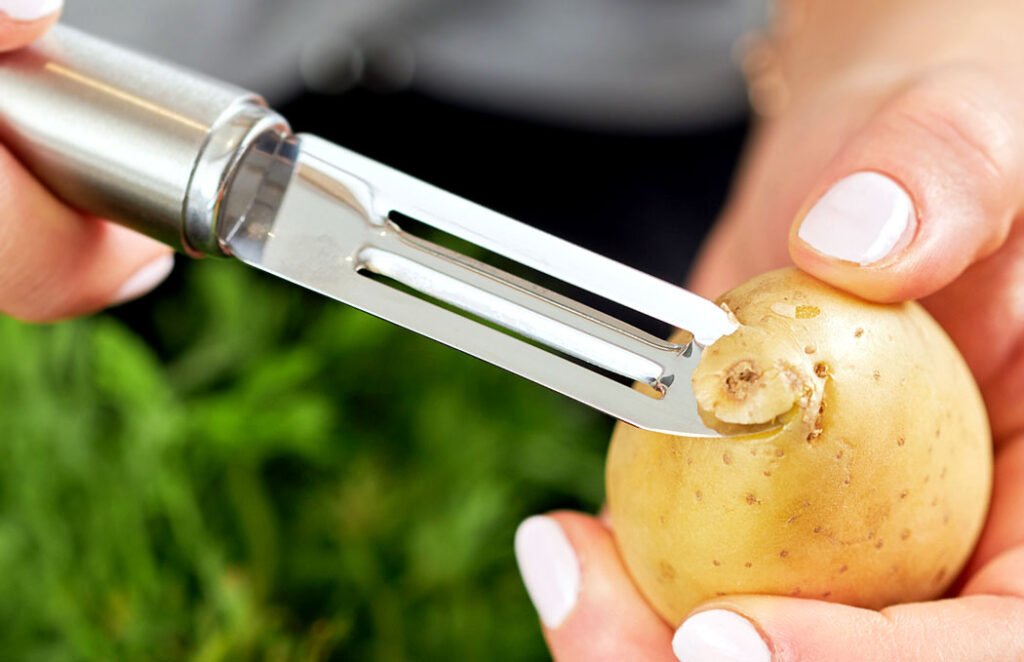
There are two main types of peelers you’ll run into. The Y-peeler, which looks like a small fork, and the straight peeler, which looks like a knife with a slot. Most beginners find the Y-peeler easier to control because it sits naturally in your hand and doesn’t require twisting your wrist as much.
Straight peelers are faster once you get used to them, and they work well for long vegetables like carrots or zucchini. For everyday potato peeling tools, the Y-peeler is the safer starting point. Try both if you can, and stick with whatever feels stable in your hand.
2. Wash the Potato First
Always rinse your potato before you peel it. Dirt and grit on the skin can scratch the blade over time, and nobody wants sandy bits ending up in the peel pile or on their hands. A quick scrub under cold water is all it takes.
Pat the potato dry after rinsing. A wet, slippery potato is a dropped potato, and dropped potatoes have a habit of landing on feet. Dry hands and a dry potato give you the grip you need to work quickly and safely. This step takes ten seconds. Don’t skip it.
3. Start at the Top and Work in Sections
Don’t just drag the peeler randomly across the potato. Start at one end, usually the top, and peel in one smooth downward stroke. Then lift, move over slightly, and do another stroke right next to the first one. Work your way around the potato in neat sections, like peeling lanes on a road.
This method makes sure you don’t miss any spots, and it keeps the depth even. Random peeling means you’ll double over some areas and miss others entirely. Sections keep you organized, and the whole thing goes faster than you’d expect once you build the rhythm.
4. Rotate as You Go
After you peel one side, rotate the potato a quarter turn and peel the next side. Keep rotating until the whole potato is done. This is much easier than trying to twist your wrist into awkward angles to reach the back of the potato.
Think of the potato like a globe. You’re peeling it in strips from pole to pole, turning it as you go. This also makes it easier to spot any missed patches of skin, because you’re always looking at a fresh section with each rotation. Proper potato preparation really does start with this small habit.
5. Use the Tip to Remove Eyes and Blemishes
Most peelers have a small pointed notch at one end of the blade. That’s not decoration. It’s for digging out the eyes, those small dark spots and sprouts that the flat blade can’t get cleanly.
Press the tip into the eye at a slight angle, rotate the peeler in a small circle, and the eye pops right out. You lose almost no potato flesh this way. If you try to cut eyes out with a knife, you end up carving out a much bigger chunk than you need. The tip on the peeler exists for exactly this reason, so use it.
6. Rinse the Peeled Potato Right Away
Once the potato is peeled, rinse it under cold water immediately. This washes off any stray bits of skin still clinging to the surface, and it also slows down the browning that happens when peeled potato flesh hits air.
If you’re not cooking straight away, put the peeled potatoes in a bowl of cold water. They’ll stay white and fresh for a couple of hours this way. This is the same trick restaurants use when they prep vegetables in advance for a busy service. Cold water is your friend here. Don’t leave peeled potatoes sitting dry on a cutting board.
Quick Summary:
- Use a Y-peeler if you’re new to this, it’s easier to control
- Always wash and dry the potato before peeling
- Peel in sections from top to bottom, not randomly
- Rotate the potato as you go instead of twisting your wrist
- Use the pointed tip to remove eyes cleanly
- Drop peeled potatoes into cold water to stop browning
Does It Matter Which Direction You Peel?
Yes, and it makes a bigger difference than you’d think. Peeling in the wrong direction causes the blade to catch, drag, and tear the skin instead of slicing through it cleanly. Direction controls everything.
Always peel away from your body. Pull the peeler toward you and it’ll eventually slip and head straight for your fingers. It sounds obvious until you’re rushing dinner and stop thinking about it. Away from your body, every time.
Peel with the natural curve of the potato where you can. Potatoes aren’t flat, and fighting against their shape wears out your hand fast. When you peel along the curve, the blade glides and the stroke feels effortless. Against the curve, it skips and drags.
For the best kitchen peeling technique, go from top to bottom in one smooth stroke. Don’t go side to side unless you’re working on a stubborn patch. Long strokes remove more skin in less time and leave a cleaner surface behind.
- Always peel away from your body, never toward it
- Follow the curve of the potato, not against it
- Use long strokes, not short choppy ones
- Peel from top to bottom for the cleanest result
- Adjust direction for tricky bumpy sections
- Keep the blade flat against the surface, not angled
Final Thoughts
I hope this takes all the frustration out of peeling potatoes for good. It really is one of those small kitchen skills that nobody teaches properly, but once you get it right, it feels effortless. Good grip, smooth strokes, rotate as you go, and use that tip for the eyes. That’s all it takes. You’ve got this, and the next batch of mashed potatoes is going to be much better for it.
| Topic | What to Do | Why It Matters | Common Mistake | Quick Fix | Skill Level |
|---|---|---|---|---|---|
| Peeler Type | Use a Y-peeler for beginners | Easier grip and control | Using the wrong type for the job | Try both and see what feels stable | Beginner |
| Grip | Hold like a thick marker, wrist relaxed | Controls blade angle and pressure | Squeezing too tight | Loosen your grip, let the blade do the work | Beginner |
| Potato Hold | Curl fingers inward, firm but gentle | Keeps fingers safe, potato steady | Gripping flat with open fingers | Make a loose fist around the potato | Beginner |
| Washing | Rinse and dry before peeling | Removes grit, improves grip | Peeling a wet, dirty potato | Quick rinse, pat dry, then peel | Beginner |
| Stroke Direction | Peel away from body, top to bottom | Safer, cleaner, faster | Peeling toward yourself or side to side | Always push or pull the blade away from your body | Beginner |
| Sections | Peel in vertical strips, rotate potato | Even coverage, no missed patches | Random peeling in all directions | Work in lanes like mowing a lawn | Beginner |
| Eye Removal | Use the notch tip on the peeler | Removes eyes with minimal waste | Cutting out eyes with a knife | Press tip in, rotate, pop it out | Beginner |
| Pressure | Light and consistent | Removes only skin, not flesh | Pressing too hard and carving into the potato | Let the blade’s sharpness do the cutting | Beginner |
| Post-Peel Care | Rinse and place in cold water | Stops browning, keeps potatoes fresh | Leaving peeled potatoes out in the air | Keep a bowl of cold water ready before you start | Beginner |
| Blade Maintenance | Rinse and dry peeler after every use | Keeps blade sharp longer | Leaving it wet in the sink | Wash, dry, and store it handle-up | All levels |
| Speed | Build a rhythm, don’t rush | Faster and safer once you find your rhythm | Rushing and losing control of the peeler | Start slow, speed comes naturally | Beginner |
| Vegetable peeling basics | Same technique works for carrots, zucchini, and parsnips | Versatile skill for the whole kitchen | Thinking peeling technique is only for potatoes | Practice on different vegetables to get faster | Beginner |
Frequently Asked Questions
Is a Y-peeler better than a straight peeler?
For most beginners, yes. A Y-peeler sits naturally in your hand and needs less wrist twisting. A straight peeler is faster for long vegetables like carrots once you get comfortable. Try both and stick with what feels steady.
Can I use a potato peeler on other vegetables?
Absolutely. It works great on carrots, zucchini, parsnips, cucumbers, and even apples. The same technique applies, smooth strokes, follow the curve, peel away from your body. A good peeler is one of the most useful tools in any kitchen.
Are ceramic peelers better than stainless steel?
Ceramic blades stay sharp longer and don’t rust. But they chip more easily if you drop them. Stainless steel peelers are tougher and easier to replace. For everyday home use, a good stainless steel peeler is more practical and much cheaper.
Do I need to peel potatoes for every dish?
No. Dishes like potato salad, roasted potatoes, and soups often taste better with the skin on. The skin holds nutrients and adds texture. Only peel when you need a smooth result, like mashed potatoes or gnocchi.
Is it faster to peel potatoes before or after boiling?
After boiling is actually faster. The skin slips right off with your fingers or a cloth once the potato is cooked. But for most recipes, you peel before cooking. It depends on the dish you’re making.
Can a dull peeler damage the potato?
Yes. A dull blade drags instead of slices, so you end up pressing harder and carving into the flesh. You waste more potato and tire out your hand faster. Replace or sharpen your peeler when it starts to feel like it’s tearing instead of gliding.
Are there any safety tips for kids using a peeler?
Kids can learn to peel with a Y-peeler, starting around age 8 or 9 with supervision. Teach them to always peel away from their body, keep fingers curled, and go slowly. A dull peeler is actually more dangerous because it requires more force and slips more easily.
Do peelers need special cleaning or care?
Just wash them with dish soap and dry them right away. Leaving a peeler wet causes rust on the blade over time, especially on cheaper models. Store it somewhere dry, not loose in a drawer where the blade can chip against other utensils.Meta Description: Learn how to use a potato peeler the right way, grip, stroke, and all. Simple tips that make peeling faster, safer, and mess-free!
