
As an Amazon Associate, I earn from qualifying purchases at no extra cost to you.
How Long to Dehydrate Bananas in an Air Fryer (Expert Guide)

Most people think dehydrating bananas takes special equipment. It does not. The struggle is real though. You slice the bananas, try the oven, and end up with soggy or burnt slices that nobody wants to eat. So this guide covers exactly how to dehydrate bananas in an air fryer, the right temp, the right time, and all the little tricks that actually make a difference.
Key Takeaways: Set your air fryer to 135°F (57°C) for best results. Slice bananas thin, about ⅛ inch, so they dry evenly. Place slices in a single layer with space between each one. Dehydrating takes roughly 6 to 8 hours at low temp, but check every hour after the 4-hour mark. Flip the slices halfway through for even drying. Let them cool fully before storing, because they crisp up more as they cool down.
How Long Does it Take to Dehydrate Bananas in an Air Fryer?
The short answer is 6 to 8 hours at around 135°F. But honestly, the real answer depends on a few things. The thickness of your slices matters a lot. So does how ripe your bananas are, because riper ones have more moisture and take longer to dry out completely.
Thin slices, about ⅛ inch, dry faster and come out chewier. Thicker slices take longer and stay a little softer in the middle. Neither is wrong. It just depends on what texture you are going for in the end.
After about 4 hours, start checking every 30 to 45 minutes. You want the slices to look dry and leathery, not wet or sticky. They should bend a little without breaking, and they should not feel soft or damp in the center.
One more thing worth knowing: they firm up even more after cooling. So do not judge the final texture while they are still warm. Give them 10 to 15 minutes on a wire rack first.
- Ripe bananas take longer because they hold more moisture inside
- Slice thickness directly controls how long the drying takes
- Low and slow is always better than high heat and fast
- Check every 30 to 45 minutes after the 4-hour mark
- Cool them completely before deciding if they need more time
- Leathery and slightly bendable is the texture you are looking for
How to Dehydrate Bananas in an Air Fryer Step by Step
Pick the Right Bananas for Dehydrating
Start with bananas that are just ripe. Not green, not overly spotty brown. A little yellow with a few spots is the sweet spot. Those ones have enough natural sugar to taste great dried, but they are not so soft that they fall apart when you slice them.
Overripe bananas are trickier. They are mushier and have way more moisture, so the drying time goes up. They also stick more to the air fryer tray. Still works, but you will need to be more patient and watch them closely during the last couple hours.
If you have bananas that are close to turning, this is a great way to use them up instead of tossing them out. Just know going in that riper ones take a bit more time and attention.
- Yellow bananas with a few spots work the best for this
- Green bananas are too firm and will not taste sweet after drying
- Very ripe bananas work but need longer drying time
- Do not mix very ripe and just-ripe bananas in the same batch
- Organic bananas are great since the peel is not going in anyway
- Buy a few extra because they shrink down a lot after drying
Slice the Bananas to the Right Thickness
Even slicing is everything here. Cut too thick and the middle stays wet. Cut too thin and they burn or turn too crispy. Aim for ⅛ inch slices, which is roughly the thickness of two stacked coins.
A sharp knife works fine for this. But if you want perfectly even slices every single time, a mandoline slicer is a total game changer. It takes maybe 30 seconds per banana and every slice comes out exactly the same. Even slices mean even drying, and that is what you really want.
Try to keep all the slices as consistent as possible. Mixed thicknesses in the same batch means some slices finish early while others are still wet. Then you end up pulling some out early and leaving others in, which just makes things more complicated than they need to be.
- Aim for ⅛ inch slices for the best chewy texture
- A mandoline slicer makes this much faster and more consistent
- Uneven slices lead to uneven drying in the same batch
- Cut straight across for round chips instead of long strips
- Dry the slices with a paper towel before placing in air fryer
- Do not stack or overlap slices on the tray
Set the Right Temperature in Your Air Fryer
This is the part most people get wrong first time around. They crank the heat up thinking it will go faster. But high heat just cooks the outside while the inside stays wet. Low and slow is the only way to actually dry them out properly.
Set your air fryer to 135°F if it has a dehydrate setting or allows that low of a temp. Some air fryers only go as low as 150°F or 160°F. If that is your situation, use the lowest setting you have and just check more often, because the higher temp means faster drying and more chance of burning the edges.
Not every air fryer has a dehydrate mode, and that is totally fine. The key is just low heat and good airflow. If your model runs hot even on the lowest setting, try propping the basket slightly or adding a small piece of foil under the bananas to slow things down a bit.
- 135°F is the ideal temp for dehydrating bananas in an air fryer
- Never go above 160°F or the edges will start to cook instead of dry
- Use the dehydrate setting if your air fryer has one
- Preheat for 5 minutes before adding bananas for more even drying
- Check your air fryer manual for the lowest available temp setting
- A thermometer inside the basket confirms your actual temp is accurate
Arrange the Slices Without Overlapping
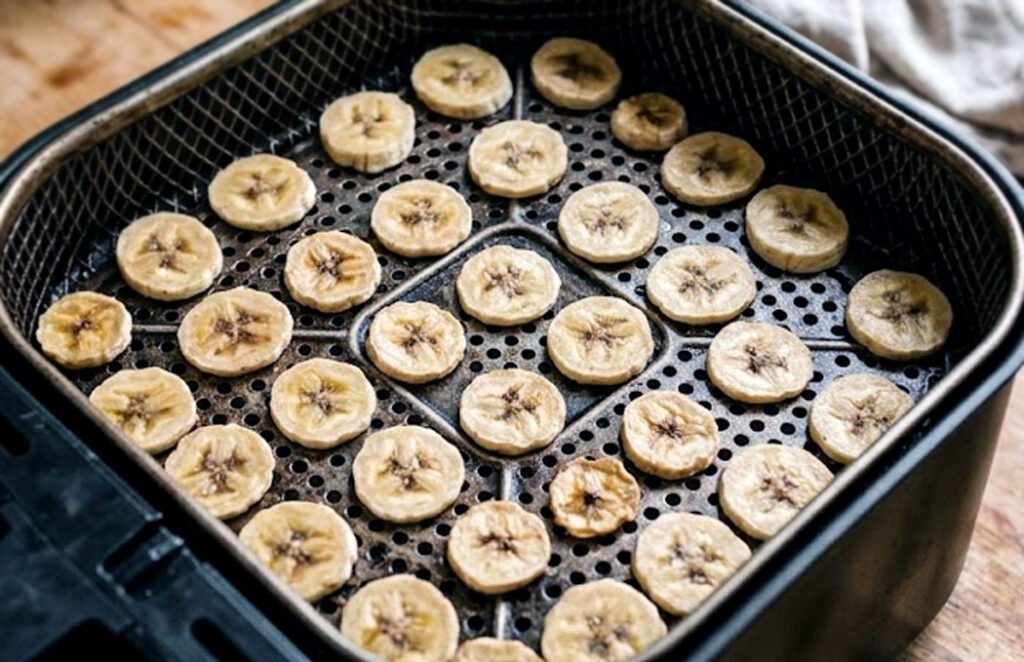
Layout sounds like a small thing, but it really makes a big difference. Every slice needs air flowing around it. If slices are touching or overlapping, those spots will stay soft and wet even after hours of drying. You will end up with some perfect slices and some still-damp ones in the same batch.
Lay each slice flat with a little gap between them. Think of it like giving each slice its own little breathing room. If your air fryer basket is small, work in batches instead of cramming everything in at once. Crowding is the fastest way to ruin a batch.
Some air fryers come with dehydrator racks or wire trays that stack. If yours does, use them. More rack space means more slices fit without touching, which means more chips done at the same time without sacrificing quality.
- Single layer only, no overlapping slices at all
- Leave at least a small gap between each slice for airflow
- Use stacking racks if your air fryer came with them
- Do batches if needed rather than overcrowding the basket
- Check that nothing has shifted after the first hour of drying
- Smaller air fryer baskets mean fewer chips per batch
Flip the Slices Halfway Through
At around the halfway mark, flip every slice over. This one step makes a noticeable difference. The bottom side sits against the tray and gets less airflow, so it dries slower than the top. Flipping evens that out and gets you a more consistent result across the whole batch.
Set a timer so you do not forget. It is easy to walk away and lose track of time. Around the 3 to 4 hour mark is when you want to do the flip. Use a small spatula or even your fingers if they have cooled down enough. Be gentle because the slices are still a bit soft at this stage.
After flipping, go back to checking every 30 to 45 minutes. The second half of drying goes faster than the first, so do not just set a timer and walk away. Keep an eye on the color and texture as you get closer to the finish line.
- Flip all slices around the 3 to 4 hour mark
- Use a small spatula to avoid tearing the soft slices
- The bottom side always dries slower, so flipping matters
- After flipping, check every 30 to 45 minutes until done
- Look for a golden color and dry, leathery surface
- Do not rush it, better to under-flip than to skip it completely
Know When the Bananas are Fully Dehydrated
This is where a lot of first-timers mess up. They pull the chips too early because they look done in the air fryer. But then after cooling, the center is still chewy in the wrong way, almost damp-feeling. That means they needed more time.
The right texture is leathery and slightly bendable. Press one gently between your fingers. It should feel dry all the way through, not squishy or tacky. If it sticks to your fingers at all, it needs more time. If it snaps in half cleanly, it might be a touch overdone but still totally good to eat.
Let a few test pieces cool on the counter for 10 minutes before you decide they are finished. They firm up as they cool, so what feels slightly soft in the air fryer often becomes perfectly chewy once cooled down all the way.
- Leathery and bendable is the goal, not crispy or snapping
- Press gently with fingers, it should feel dry and not tacky
- Let a test piece cool 10 minutes before judging the texture
- Golden or light brown color means you are in the right zone
- Dark brown edges are fine but fully black means too long
- If in doubt, give it 30 more minutes and check again
Can You Dehydrate Bananas at a Higher Temperature to Save Time?
A lot of people wonder this. And yes, technically you can bump the temp up a bit. But there is a catch. Anything above 160°F starts cooking the banana instead of just drying it out. The outside sets and hardens before the inside moisture has a chance to escape properly.
What happens then is not great. You get chips that look done on the outside but feel chewy or even wet in the middle. Or the edges go dark and bitter while the center is still soft. Neither one is what you are going for with dehydrated banana chips.
If you are really short on time, go up to 150°F or 155°F at most. Check every 20 to 30 minutes and pull them the second they feel right. The difference in time is maybe an hour shorter, but you do trade some quality for that convenience.
The best batches always come from the lower temp and more time approach. It takes patience, but the result is a much more even, chewy chip that stores better and tastes sweeter too.
- High temps cook the outside before the inside can dry out
- 150°F to 155°F is the highest you should ever go
- High heat leads to dark edges and a wet center
- Lower temp gives you more control over the final texture
- Faster is not always better when it comes to dehydrating
- Check more often if you do choose a higher temp setting
What is the Best Way to Store Dehydrated Banana Chips?
Storage is just as important as the drying process. If you do it wrong, all that time spent in the air fryer goes to waste pretty fast. The biggest enemy of dehydrated bananas is moisture. Even a little bit of humidity gets in and makes them go soft or even start to mold.
Let the chips cool completely before putting them anywhere. This is a step that really cannot be skipped. Warm chips put into a sealed container create condensation inside, which adds moisture right back in. Give them at least 15 to 20 minutes on a wire rack before storing.
An airtight container is what you need. A mason jar with a tight lid works great. So does a zip-lock bag with all the air pressed out before sealing. Keep them at room temperature in a cool, dry spot away from sunlight. A pantry or cabinet works perfectly for this.
Done right, they will last 2 to 4 weeks at room temperature. In the fridge, they can go up to 2 months. In the freezer, even longer than that. Just let them come back to room temp before eating from the freezer.
- Always cool completely before sealing in any container
- Airtight containers are a must, mason jars work well
- Press air out of zip-lock bags before sealing them shut
- Keep away from sunlight and heat sources in your kitchen
- Room temp storage works for up to 2 to 4 weeks
- Refrigerator or freezer extends shelf life significantly
Final Thoughts
We hope this answered exactly how long to dehydrate bananas in an air fryer and made the whole process feel way less confusing. Start at 135°F, slice thin, be patient, and let them cool before you judge the texture. Your first batch might not be perfect. That is totally fine. Try it again with what you learned, and next time it will be better. You have got this.
| Factor | Details | Beginner Tip | Time Impact | Common Mistake | Best Practice |
|---|---|---|---|---|---|
| Temperature | 135°F is ideal | Use dehydrate mode if available | Low temp means longer but better drying | Going too high and burning edges | Always start at the lowest setting |
| Slice Thickness | ⅛ inch is perfect | Use a mandoline for even cuts | Thicker slices add 1 to 2 hours | Cutting too thick or uneven | Keep all slices the exact same size |
| Ripeness of Banana | Just ripe is best | Yellow with a few small spots only | Overripe adds extra drying time | Using overly soft mushy bananas | Avoid green or very overripe bananas |
| Arrangement | Single layer only | Never overlap or stack slices | Crowding adds time and ruins texture | Stacking slices to fit more in | Give each slice space around it |
| Flipping | Flip at hour 3 or 4 | Use a small spatula gently | Skipping adds uneven drying time | Forgetting to flip halfway through | Set a reminder timer to flip |
| Cooling Time | 15 to 20 minutes | Cool on a wire rack fully | Skipping cooling gives wrong texture read | Storing warm chips in container | Always cool before sealing away |
| Total Drying Time | 6 to 8 hours typical | Check every 30 to 45 min after hour 4 | Riper bananas take the full 8 hours | Pulling them out too early | Do a bend test before removing |
| Storage Method | Airtight jar or bag | Press out all air before sealing | Bad storage cuts shelf life fast | Leaving them in an open bowl | Use mason jars or vacuum seal bags |
| Shelf Life | 2 to 4 weeks at room temp | Store in a cool, dark cabinet | Humidity shortens shelf life fast | Storing near the stove or window | Fridge extends to up to 2 months |
| Texture Goal | Leathery and bendable | Let cool before judging texture | Rushing check leads to wrong call | Expecting crispy chips right away | Bend test is the most reliable check |
Frequently Asked Questions (FAQs)
Is it Safe to Dehydrate Bananas in Any Type of Air Fryer?
Yes, it is safe as long as your air fryer can go low enough in temperature. You need at least 135°F to 150°F for this to work properly without cooking them.
Can I Dehydrate Frozen Bananas Instead of Fresh Ones?
You can, but thaw them first and pat them very dry. Frozen bananas release a lot of extra moisture, so drying time will be noticeably longer than with fresh ones.
Do I Need to Add Lemon Juice Before Dehydrating?
You do not have to, but a light brush of lemon juice slows browning and adds a subtle tang. It is totally optional and does not change the drying time at all.
Is a Dehydrator Better Than an Air Fryer for Bananas?
A dedicated dehydrator runs quieter and fits more trays. But an air fryer gives very similar results in less space. For small batches at home, an air fryer works perfectly fine.
Can I Add Cinnamon or Other Spices Before Drying?
Absolutely yes. Sprinkle cinnamon, nutmeg, or even a tiny bit of chili powder before putting them in. Spices stick well and add great flavor to the finished chips.
Do I Need to Peel the Bananas Before Dehydrating?
Yes, always peel them first. The peel does not dry out the same way the fruit does. Slice the peeled banana and then lay them directly onto your tray.
Is It Normal for Banana Chips to Look Soft Right Out of the Air Fryer?
Yes, totally normal. They feel soft when warm and firm up as they cool. Always let them sit for at least 10 to 15 minutes before deciding if they need more drying time.
Can I Make These Without a Dehydrate Setting on My Air Fryer?
Yes, just use the lowest temperature your air fryer allows. Check more often and pull them when they feel dry and leathery. The dehydrate setting just makes it easier, not essential.
